
|
The journal Automotive Innovation is sponsored by China SAE, published through Springer, distributed around the world, and reflects the top-level research and technical advance of automotive engineering. Automotive Innovation newsletter in April includes the following contents: 1. A Glimpse of Experts——Prof. Levent Guvenc 2. Article Recommendation——Four papers on HMI 3. China SAE News: · FISITA Intelligent Safety Conference China is Rescheduled |

 Prof. Levent Guvenc |
Research Interests Intelligent and Connected Vehicle Technologies |
||
|
Achievements Prof. Levent Guvenc works in the Mechanical & Aerospace Engineering at The Ohio State University, and he is the director of the Automated Driving Lab. Prof. Levent Guvenc started his career in the area of robotics and control systems after he received his PhD from the Department of Mechanical Engineering (MAE) at The Ohio State University in 1992. His research has always concentrated on automatic control and mechatronic systems ranging from control of atomic force microscope scanning to helicopter stability and control systems. Since 2000, his research focus has been automotive control systems, especially active safety systems such as electronic stability control and advanced driver assistance systems. Since 2007, his research has concentrated more on vehicle automation and automated driving. For many years, he has been engaged in the research of connected and automated driving. He has published over 200 papers in international journals and conferences, written 6 books, obtained 6patents and completed research projects funded by the US government, enterprises and the European Union. He was the General Chair of IEEE Intelligent Vehicles Symposium, İstanbul, Turkey (2007). Keen in promoting international technological exchanges and cooperation, he has given lectures in many universities and institutions in US, Turkey and many European countries. |

  
|
Personality Openness Predicts Driver Trust in Automated Driving Wenmin Li · Nailang Yao · Yanwei Shi · Weiran Nie · Yuhai Zhang · Xiangrong Li · Jiawen Liang · Fang Chen · Zaifeng Gao |
||
| Maintaining an appropriate level of trust in automated driving (AD) is critical to safe driving. However, few studies have explored factors affecting trust in AD in general, and no study, as far as is known, has directly investigated whether driver personality influences driver trust in an AD system. The current study investigates the relation between driver personality and driver trust in AD, focusing on Level 2 AD. Participants were required to perform a period of AD in a driving simulator, during which their gaze and driving behavior were recorded, as well as their subjective trust scores after driving. In three distinct measures, a significant correlation between Openness and driver trust in the AD system is found: participants with higher Openness traits tend to have less trust in the AD system. No significant correlations between driver trust in AD and other personality traits are found. The findings suggest that driver personality has an impact on driver trust in AD. Theoretical and practical implications of this finding are discussed. | |||
|
Keywords: Automated driving · Trust · Personality · Openness Li, W.M., Yao, N.L., Shi Y.W., et al.: Personality openness predicts driver trust in automated driving. Automot. Innova. 3(1): 3-13 (2020) |
|||
| Full Paper Reading>> | |||

|
Automated Vehicle Handover Interface Design: Focus Groups with Learner, Intermediate and Advanced Drivers Jediah R. Clark · Neville A. Stanton · Kirsten M. A. Revell |
||
| Conditionally and highly automated vehicles will require drivers to take control as a result of a non-emergency, such as a geographical, terrain, capability or design boundary. It is anticipated that these events will provide the driver with a sufficient amount of time to prepare themselves for the transition of control. This study explores conditionally and highly automated vehicle transitions of control by asking how drivers of differing skill levels (learner, intermediate and advanced) approach the task of designing an interface responsible for making transitions safer, more usable and more efficient. Three focus groups generated detailed designs for vehicle-to-driver transitions in an 1-h and a 10-min “out-of-the-loop” scenarios and transitions from driver to vehicle. Results show great variation in the approaches taken by each skill group (e.g., the reliance on visual interfaces for awareness assist and viewpoints on issues such as multimodal displays). Customization was a common theme throughout, with drivers desiring the option to adjust alert timings and modalities in which information is displayed. This paper presents these designs along with a detailed comparison of group designs and implements distributed situation awareness theory to discuss findings and draw conclusions. | |||
|
Keywords: Handover · Takeover · Level 3 automation · Interface design · Automobile Clark, J.R., Stanton, N.A., Revell, K.M.A. : Automated vehicle handover interface design: focus groups with learner, intermediate and advanced drivers. Automot. Innov. 3(1): 14–29 (2020) |
|||
| Full Paper Reading>> | |||

|
Constraining Design: Applying the Insights of Cognitive Work Analysis to the Design of Novel In-Car Interfaces to Support Eco-Driving Craig K. Allison · Neville A. Stanton |
||
| The design with intent (DwI) toolkit assists designers in creating novel designs and interfaces. DwI, however, is not constrained to any degree, making it impossible to know whether the produced designs adequately account for users’ needs. In contrast, cognitive work analysis (CWA) is a human factors research tool that seeks to map a system and account for users’ needs, yet does not provide clear guidelines for progressing such analysis into workable designs with which users can interact. This paper seeks to present a proof-of-concept investigation to demonstrate that DwI can be suitably constrained and validated by insights gained from CWA. CWA, in turn, benefits by having a suitable toolkit for progressing insights. Two teams of individuals without design backgrounds were able to develop mock-up in-vehicle interfaces aimed at reducing fuel use. The teams were able to use DwI toolkit to articulate the genesis of their ideas, which in turn could be directly linked to system needs identified within CWA. | |||
|
Keywords: Design with intent · Cognitive work analysis · Interface design · Eco-driving Allison, C.K., Stanton, N.A. : Constraining design: applying the insights of cognitive work analysis to the design of novel in-car interfaces to support eco-driving. Automot. Innov. 3(1): 30–41 (2020) |
|||
| Full Paper Reading>> | |||

|
Usability Assessment of Steering Wheel Control Interfaces in Motorsport James W. H. Brown · Neville A. Stanton · Kirsten M. A. Revell |
||
| In order to assess the usability of steering wheel control interfaces in motorsport, it is necessary to employ a set of appropriate methods. The method selection process first involves identifying the relevant motorsport-based usability criteria. The unique factors associated with context of use in motorsport are then defined. These are employed to synthesize a set of key performance indicators (KPIs) that require specific analysis. The first KPI relates to error rates; these should be minimized, particularly under high cognitive load on the primary. The second KPI involves task times; these should be minimized not just to reduce distraction, but also to improve competitive performance. The third KPI states that usability should be optimized to minimize visual distraction. The fourth KPI advocates the minimizing of interface task load to reduce the effect on the primary task. The final KPI states that interface functionality should be easy to learn and recall. The KPIs provide clear goals to guide the identification of the most appropriate methods for each aspect of usability. Methods categories are devised and sets of appropriate methods selected based on the KPIs. These then combine into a toolset with an associated application process with the overall goal of providing a means by which motorsport interfaces may be both analysed and improved. | |||
|
Keywords: Usability · Motorsport · Steering wheel · Analysis · Assessment Brown, J. W. H., Stanton, N. A., Revell, K. M. A. : Usability assessment of steering wheel control interfaces in motorsport. Automot. Innov. 3(1): 42–52 (2020) |
|||
| Full Paper Reading>> | |||

| FISITA Intelligent Safety Conference China is Rescheduled | |||
 China SAE (CSAE) and FISITA today announced that the second FISITA Intelligent Safety Conference, China will now be held during the China SAE Congress and Exhibition in Shanghai in October 2020. CSAE and FISITA have been monitoring the developing Coronavirus situation and discussing current precautions being taken by their member companies and have decided that rescheduling the conference will create sufficient time to support the confident delivery of a well-attended, international conference of the highest technical quality. FISITA CEO Chris Mason said “While constantly monitoring the Coronavirus situation and discussing the evolving situation with CSAE colleagues and other partners, we’re grateful that CSAE has the option to host us at its Shanghai Congress and Exhibition in October. Our thoughts are with friends, colleagues and partners all around the world, and especially everyone in China, who are affected by this situation and we hope that it is resolved rapidly.” “One of CSAE’s major goals is to promote international exchanges and cooperation on novel automotive technology,” said CSAE Executive VP & Secretary General Jinhua Zhang. “We’re pleased to be working closely with FISITA on the Intelligent Safety Conference and appreciate their flexibility in fully supporting this change of timing. Technical professionals and engineers from around the world are welcomed to attend the Intelligent Safety Conference in Shanghai, where a safe and pleasing environment will be ensured.” China SAE and FISITA are currently reviewing the plans for the Intelligent Safety Conference and updated materials will be made available by the end of February. While FISITA and China SAE do not plan to re-open the Call for Papers, it is following up with sponsors and speakers to confirm their availability and continued support in October. As the rescheduling plan develops, there may be opportunities for additional topics, speakers and sponsors; if you have an interest in discussing this, please email info@fisita.com. For more information to be updated, please visit the website www.fisita.com/events/isc . |
|||
| Welcome to 2020 SAECCE | |||
 China SAE Congress & Exhibition (SAECCE) has become an influential platform with high specialization and internationalization for technical communication, with the form of combination of conferences and exhibitions. So far, it has been held for 26 years consecutively. SAECCE has attracted visitors and speakers from all over the world, who are engaged in R&D, production and project management. They are the key persons in recommending and making decisions on the development and application of new automotive technologies in the future. 2020 SAECCE will be held in Shanghai Automobile Exhibition Center from October 20 to 22, 2020. Focusing on automotive technologies including electrification, intelligent and lightweight, the events range from plenary sessions to high-level panel discussion, special session, keynote speech, technical session, technical exhibition, test drive & ride and company tour. For more information, please click here. |
|||
| Automotive Innovation Abstract Collections 2019 | |||
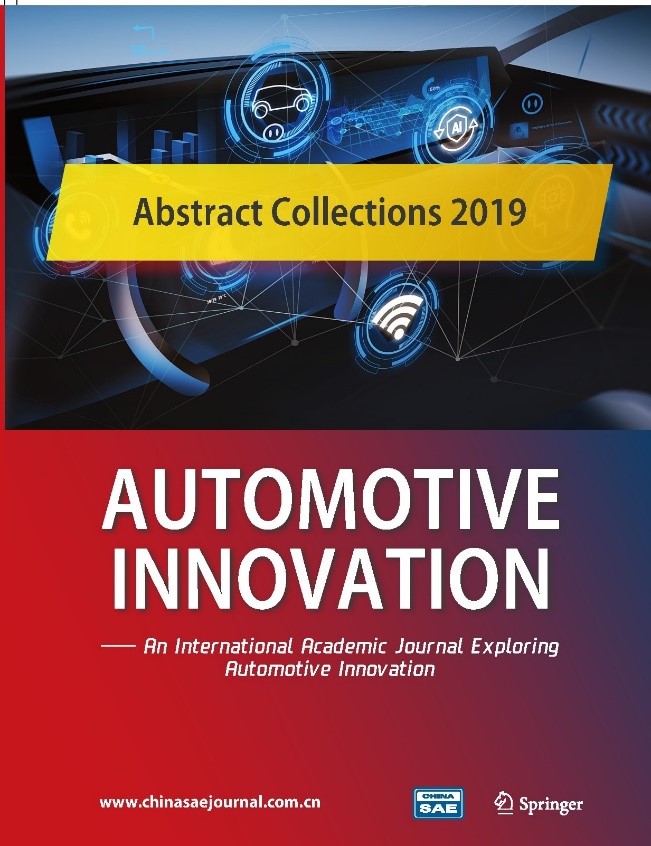 Automotive Innovation was founded by China SAE in 2017. Published via Springer Nature, the journal ensures high-quality papers satisfying international standards. Aiming to achieve a world-class level, the editorial board consists of world-renowned experts covering 15 countries and regions. The journal is published quarterly, attracting readers from 72 countries and regions. The highest download of a single article wins more than 8,000. Throughout 2019, 4 issues have been published online, with a total of 32 papers on hot topics including autonomous driving, safety, electric vehicles, car body design, engine, transmission, dynamics and NVH. All papers have gone through rigorous review process by the editor-in-chief, associate editors-in-chief and reviewers, resulting in perfect appearances of latest cutting-edge technologies. With purpose of providing more convenient access to these technical papers, the 2019 abstracts have been collected and classified on account of publication date and research areas. Dual language has also been displayed for more comfortable reading experience. Automotive Innovation Abstracts Collections 2019 is hereby presented. It is hoped that this collection enables you to gain a deeper understanding about Automotive Innovation and bring more spark and inspirations to keep you going. Please see Download to access the collection. |
|||

|
Automotive Innovation Sponsored by China SAE and published globally via Springer Nature, Automotive Innovation aims to be a world-class journal that provides abundant sources of innovative findings for automotive engineers and scientists. The journal is published quarterly, ensuring high-quality papers satisfying international standards. With the editorial board consisting of world-renowned experts, it has attracted readers from 72 countries and regions. The highest download of a single article wins more than 8,000. The journal is dedicated to the publication of peer-reviewed original papers and covers the principles, methodologies, designs, theoretical background and cutting-edge technologies in connection with the development of vehicle and mobility. The main topics include but are not limited to: energy-saving, electrification, intelligent and connected, safety and lightweight technologies. Editors-in-Chief Jun Li, Academician of CAE, President of China SAE, Professor of Tsinghua University Frank Zhao, President (2018-2020) of FISITA, President of Tsinghua Automotive Strategy Research Institute Executive Editor-in-Chief Prof. Mike Ma,Executive Chief Editor of Automotive Innovation, Professor of Jilin University, VP Technical FISITA |
||||
|
Paper submission and browse www.ChinaSAEJournal.com.cn www.springer.com/42154 Contacts: Ms. Lily Lu Tel: +86-10-50950101 Email: jai@sae-china.org |
|
|||
Sponsored by
|
Published by
|
|||